Towards Multi-language Program Verification for AI
 Raúl Raja CTO at Predictable Machines
 David Mazarro Founding Engineer at Predictable Machines

 2026

AI enables faster development, but less reliable outputs
Harder to review and keep up with code being written at a much faster pace
=
More pressing need to provide software verification solutions
The story of this talk
Testing is effective to show the presence of bugs, but not their absence
Headline!!
Edsger W. Dijkstra
How many test cases would it take?
Sometimes, testing could rule out bugs if you test all possible inputs, but:
Function | Possible inputs | Test all inputs? |
|---|---|---|
|
| yes |
|
| impractical |
|
| impossible |
... so yeah, not really
A sea of inputs
For any given program, you have a sea of possible inputs and expected behaviors
Testing doesn't cover all behavior
Formal verification
What is formal verification?
“Formal verification is a set of techniques used to prove the correctness of a program against a given formal specification”
Correctness: a program is correct if it behaves as specified
Prove: use mathematical techniquesthese are the famous formal methods! to guarantee this correctness
What is a specification?
A specification is a description of a program's behavior
function withdraw(acc: Account, amount: number): Account {
  acc.balance -= amount;
  acc.history.push({
    withdrawn: amount,
    balanceAfter: acc.balance,
  });
  if (amount >= 1000) {
    acc.flaggedForReview = true;
    sendEmail(acc.owner, "Large withdrawal");
  }
  db.accounts.save(acc);
  return acc;
}
“If amount is positive and does not exceed the account's balance, withdraw subtracts amount from the balance and records the withdrawal in some history. If amount is 1000 or more, the account is flagged for review and the account holder is emailed. It then saves the account and returns it. The balance never goes negative.”
Formal specifications through Hoare logic
Hoare logic (C. A. R. Hoare, 1969) is a logical framework useful for describing what a program does from what must hold before and after it runs
precondition program postcondition
Hoare triple
If the precondition holds before running the program , the postcondition holds after
Function contracts
Hoare logic allows us to precisely state contracts for our programs
function withdraw(acc: Account, amount: number): Account {
  acc.balance -= amount;
  acc.history.push({
    withdrawn: amount,
    balanceAfter: acc.balance,
  });
  if (amount >= 1000) {
    acc.flaggedForReview = true;
    sendEmail(acc.owner, "Large withdrawal");
  }
  db.accounts.save(acc);
  return acc;
}
Partial withdraw contract
“If amount is positive and does not exceed the account's balance [...] the balance never goes negative.”
Example: safely getting an array element
For an array a where a.get(i) throws an exception out of bounds
Example
the index must be in bounds ⟹ the returned element is the one found at position i
are the elements of a, in order
Verification tools
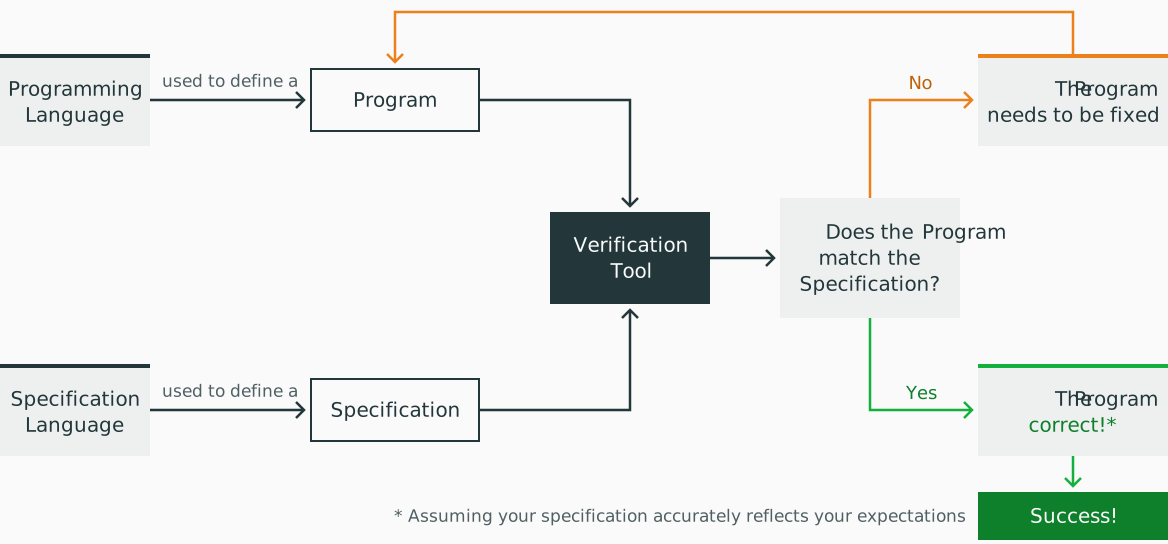
Formal verification covers all behavior
Static types
// Calculate the area of a rectangle
function findArea(x: number, y: number): number {
  return x * y;
}
Formal specification: the function findArea takes two numbers as arguments and returns a number
So the type system of your statically typed language is indeed a formal verification tool!
How this translates to functional programming
Functional programming and logic
Functions with types
Logical propositions
function checkIn(t: Ticket, id: Passport | IdCard):
    BoardingPass | Overbooked
Ticket && (Passport || IdCard)
→ BoardingPass || Overbooked
function refund(o: Overbooked): Refund
Overbooked → Refund
function board(b: BoardingPass): OnBoard
BoardingPass → OnBoard
function travel(t: Ticket, id: Passport | IdCard):
    OnBoard | Refund {
  // ?
}
function travel(t: Ticket, id: Passport | IdCard):
    OnBoard | Refund {
  return board(checkIn(t, id));
}  the Overbooked case is not handled
function travel(t: Ticket, id: Passport | IdCard):
    OnBoard | Refund {
  const result = checkIn(t, id);
  switch (result.kind) {
    case "boardingPass": return board(result);
    case "overbooked":   return refund(result);
  }
}
Ticket && (Passport || IdCard)
→ OnBoard || Refund ?✗ could not prove✓ provedboard needs a BoardingPasscheckIn gives a BoardingPass | Overbookedwe are not handling the Overbooked case, so the type checker gives an errorevery case is handled, so the type checker accepts it: it checked that our proof is sound
“Can we implement this?” = “Can we prove this?”
“We have an implementation” = “We have a proof”
Logic as types: the Curry-Howard correspondence
Check out this talk: “Propositions as Types”, Philip Wadler, Strange Loop 2015
Going back to our withdraw example
function withdraw(acc: Account, amount: number): Account {
  // ...
}
Formal specification: the function withdraw takes an account and a number as arguments and returns an account
But it is missing something…
const acc = new Account(100);

withdraw(acc, 30);   // balance: 70
withdraw(acc, 60);   // balance: 10
withdraw(acc, 50);   // balance: -40
Partial withdraw contract
Call | Type checker | Precondition | Postcondition |
|---|---|---|---|
| well-typed ✓ |
|
|
| well-typed ✓ |
|
|
| well-typed ✓ |
|
|
The type checker is still missing something to verify that the function is always called safely…
Introduction to dependent types
Types that depend on the arguments
Dependent types allow us to encode function contracts by allowing us to refer to arguments in the type itself
def get : (a : List α) → (i : Nat) →
(h : i < a.length) →
{ r : α // r = a[i] }
| x :: _, 0, _ => ⟨x, rfl⟩
| _ :: xs, i + 1, h =>
⟨get xs i (by grind), by grind [get]⟩
Contract for get
The type checker as the verification tool
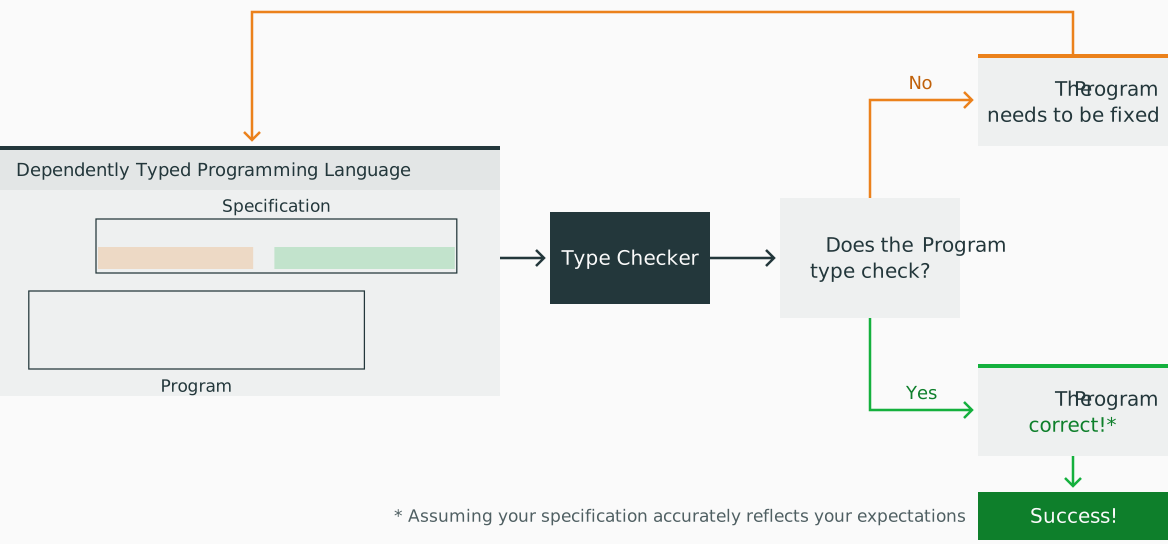
def get : (a : List α) → (i : Nat) →
(h : i < a.length) → { r : α // r = a[i] }
| x :: _, 0, _ => ⟨x, rfl⟩
| _ :: xs, i + 1, h =>
⟨get xs i (by grind), by grind [get]⟩
Contract for get
Contracts as theorems
def withdraw (acc : Account) (amount : Nat) : Account :=
-- ...
theorem withdraw_nonneg (acc : Account) (amount : Nat)
-- precondition
(h : 0 < amount ∧ amount ≤ acc.balance) :
-- postcondition
(withdraw acc amount).balance ≥ 0 := by
grind [withdraw]
Hoare triple
You can define a function with “regular” types and keep the contract as a separate theorem
Hoare triples in Lean
In Lean, there is even a dedicated syntax for Hoare triples for stateful code verification
def withdraw (amount : Nat) : StateM Account Unit := do
-- ...
theorem withdraw_spec (amount : Nat) :
⦃ fun (acc : Account) =>
0 < amount ∧ amount ≤ acc.balance ⦄
withdraw amount
⦃ fun _ acc => acc.balance ≥ 0 ⦄ := by
vcgen [withdraw]
grind
Hoare triple
A language with a dependent type system gives us a super powerful formal verification tool “for free”
“Solving” formal verification for different programming languages
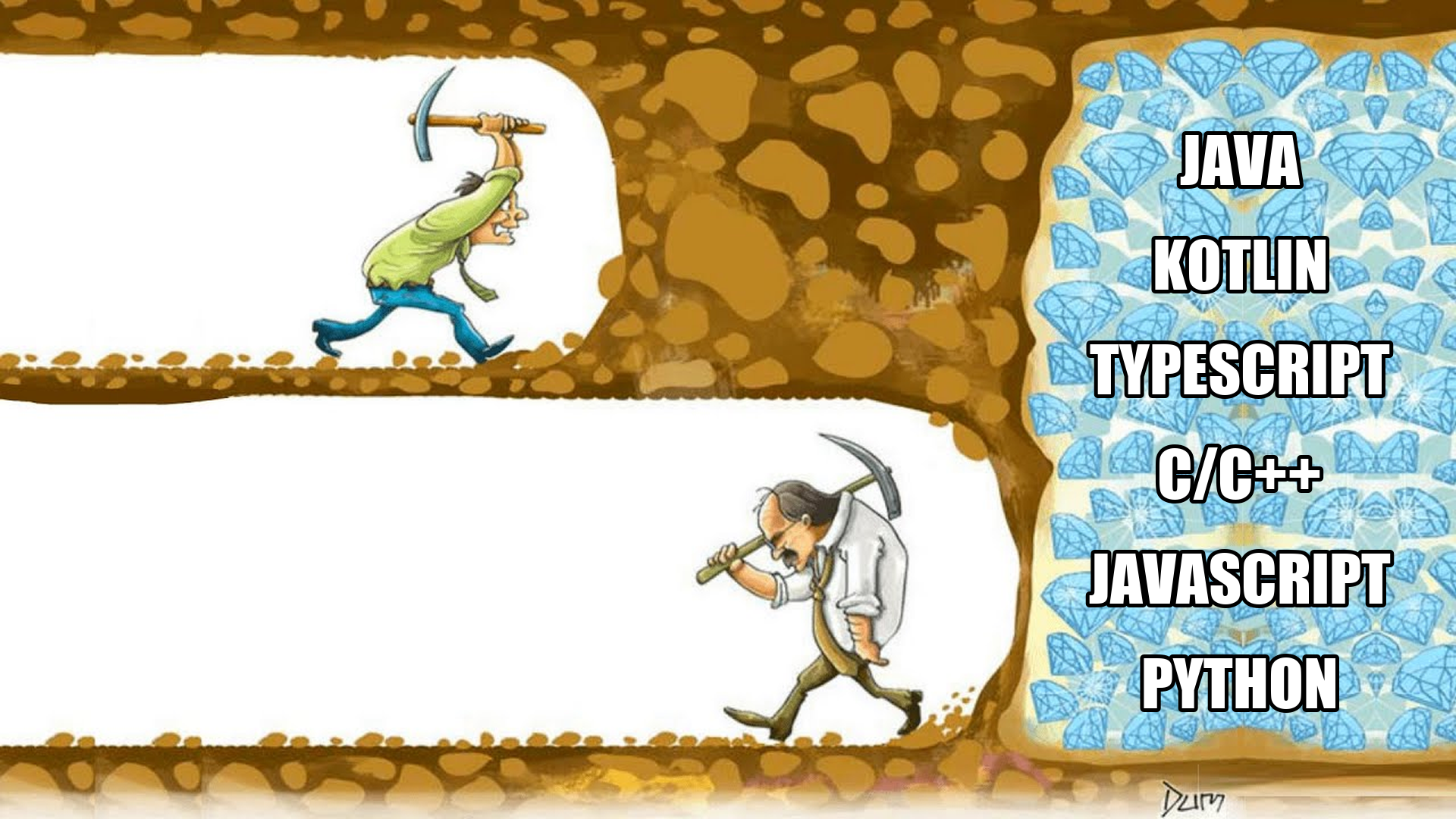
Predictable Code: our code verification platform

We are working on Predictable Code, a platform that uses formal verification techniques to reveal hidden bugs and check that code does what its requirements say, in the languages teams already use
Requirements
what the code should do,
defined as specifications
Code
aimed at languages like
Java, TypeScript or Python
Engine
being implemented in Lean
(for the most part)
One verification tool per check?
Approach #1: implement a verification tool per check
but each tool has to implement support for each programming language
One verification tool per language?
Approach #2: implement a verification tool per programming language
but each tool has to implement all the checks for each programming language
One verification tool for a common language
Approach #3 (our choice): translate programs to a common intermediate representation (IR) and implement a single verification tool for that
Our current approach for Predictable Code
We are still figuring out what works best for us and our partners
IL deciders look for structural bugs
A single IL decider detects this bug in all four languages
A dropped async call in Predictable Code
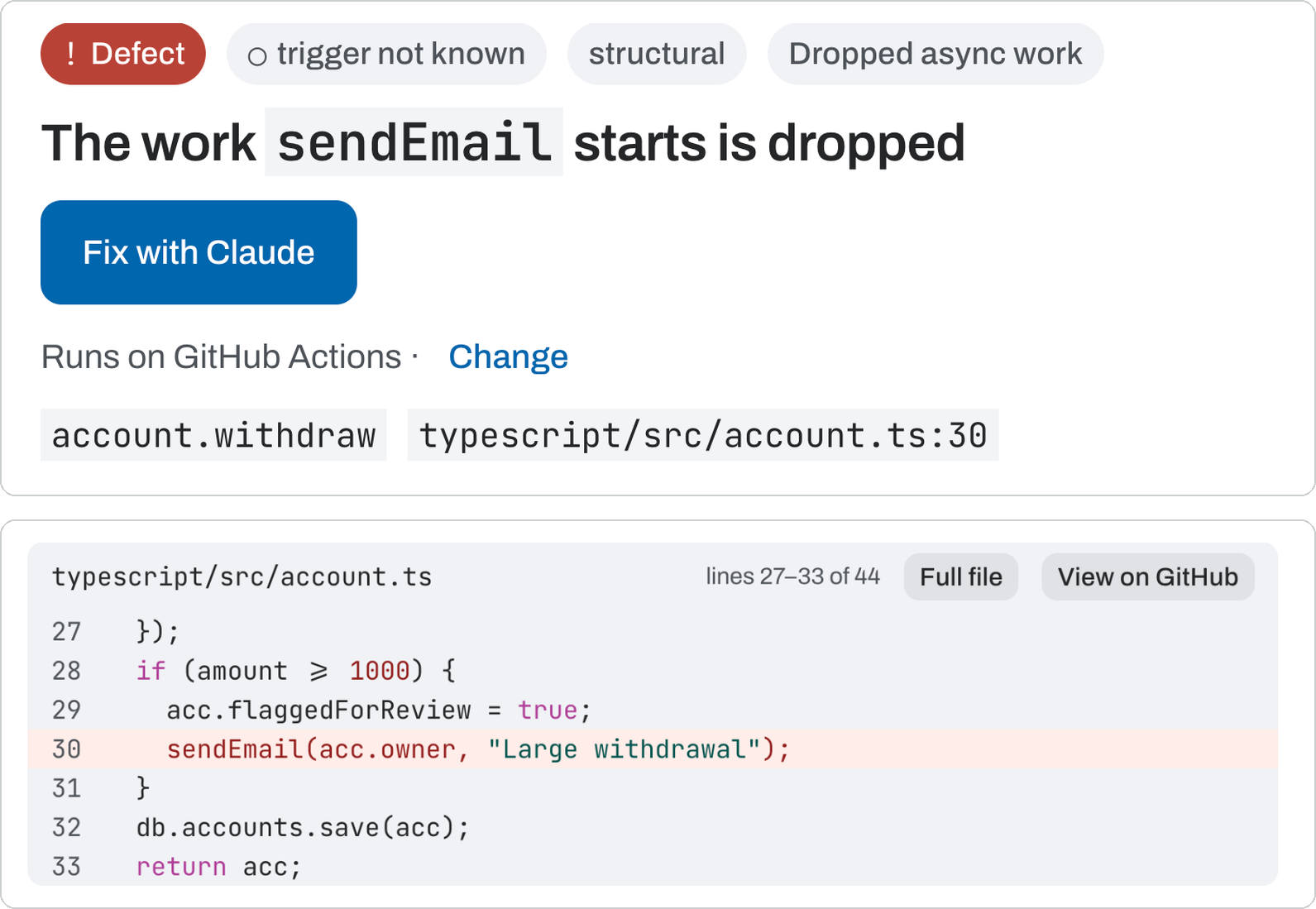
Line 30 sends the email without awaiting it
IL verifier checks requirements
function withdraw(acc: Account, amount: number): Account {
  acc.balance -= amount;
  // history, email, save
  return acc;
}
Partial withdraw contract
The returned balance acc.balance - amount may be below 0
Every caller must satisfy the precondition
Call | Precondition | IL verifier |
|---|---|---|
|
| verified ✓ |
|
| verified ✓ |
|
| violated ✗ |
The specification of withdraw in Predictable Code
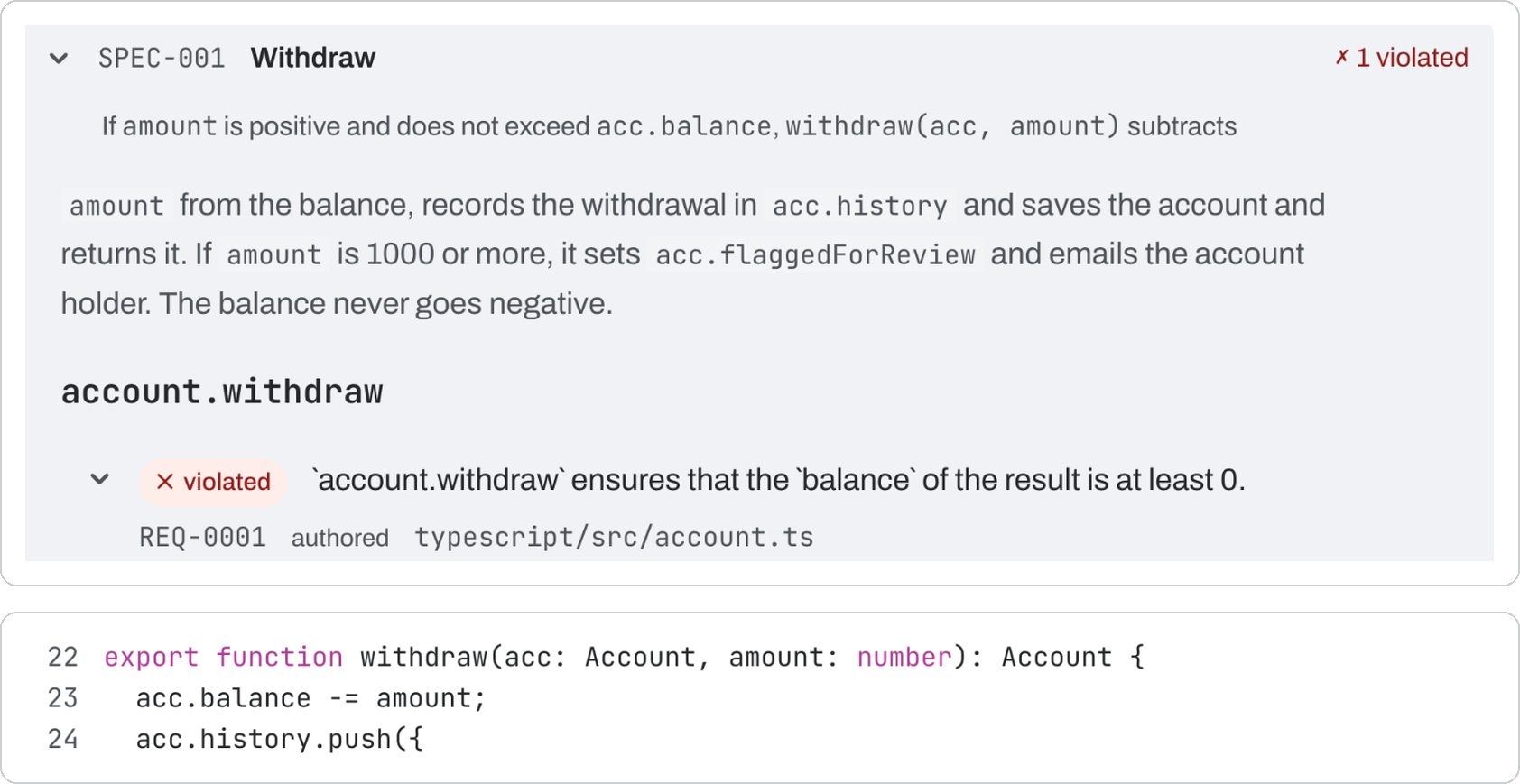
Line 23 violates the requirement that the balance never goes negative
Witness tests to reproduce bugs
The witness reproduces a violation with a test in the project's language
// generated: no dependencies
const acc = openAccount("ada", 10);
assert(withdraw(acc, 50).balance >= 0);
-
violated ✗: the test reproduces the bug, with a balance of
-40 -
held ✓: the test passes
-
unexercised: the test cannot reach the call
Towards formal semantics
Formal semantics at the different layers of the pipeline would allow for provably correct translations between software representations
Sadly, almost no mainstream programming language provides official or complete formal semantics
Our choice to build this verification platform:
A programming language with a dependent type system + interactive theorem proving capabilities
An expressive programming language and type system in the same package: huge flexibility to try different approaches to these problems
Out-of-the-box building blocks for software verification, such as vcgen
Extensibility: teams can mold and shape its capabilities to their needs
But there are others too
Lean is the trendy thing in this field as of 2026, but there are other dependently typed programming languages / theorem provers:

Agda

Idris

Rocq
Isabelle/HOL
Typical challenges, and where AI changes the picture
Where it gets better: maintenance
Software development is way faster in general, and maintenance of projects is easier now
An agent fixes withdraw, and the analysis decides when it is done
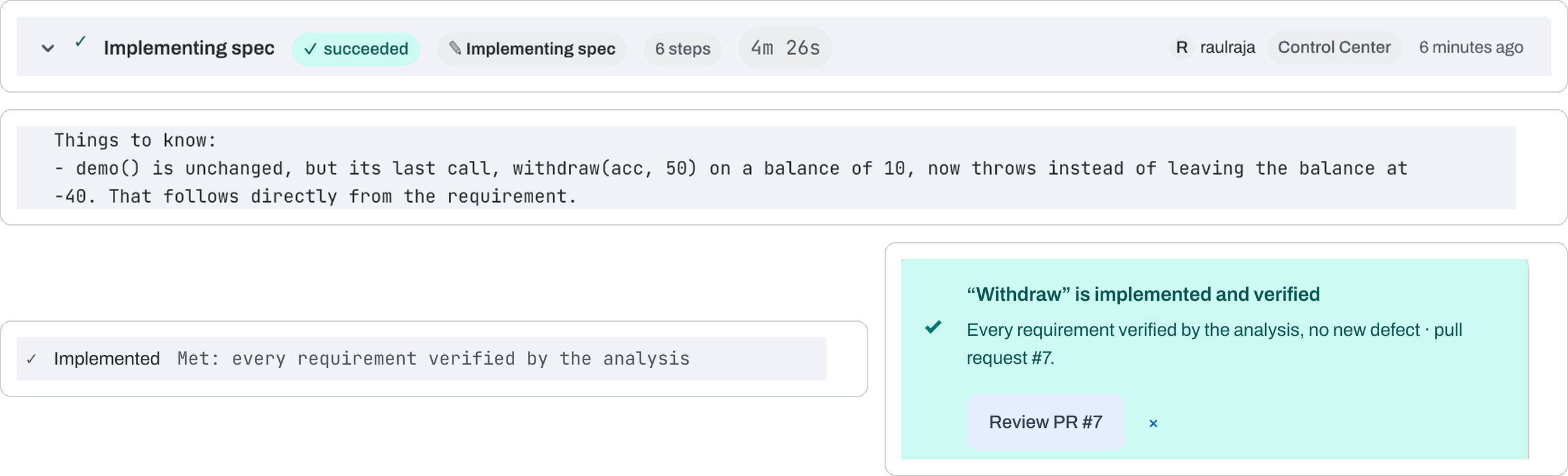
withdraw(acc, 50) on a balance of 10 now throws an error
AI challenges: autoformalization
Is > right? If “over 1000€” was meant to include 1000€, maybe it should be ≥ (and if so we are verifying the wrong requirement)
Open question: how do we check that a specification says what we meant?
AI challenges: from intent to requirements
(this is not just hard for AI, writing complete specifications is hard for humans too!)
Granularity of specifications vs. verifiability
There is no general, hands-off approach to turn natural language requirements into formally verifiable requirements
At Predictable Machines, we are navigating this spectrum to find practical verification solutions for our partners
Our takeaways
AI calls for verification solutions
Recent AI-based software development lifecycles have spurred the need for better verification solutions beyond testing and code reviews, and formal verification is one of the most promising fields for this
AI makes formal verification easier
At the same time, AI pairs exceptionally well with theorem provers, making writing complex proofs take a fraction of the time and effort (although at the expense of understanding and readability)
Formal verification is not a silver bullet
“All our endpoints must have a P99 under 500 ms”
is a valid + unambiguous + verifiable requirement, but cannot be formally verified (without making many assumptions)
Closing the gap
Questions?
Thank you!


